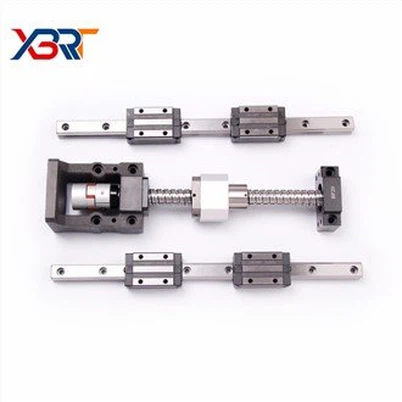


How to lubricate and maintain a ground ball screw during use?
Leave a message
As a high-precision transmission component, ball screws grinding its lubrication direct impact on transmission efficiency, service life and operating stability. Correct lubrication can reduce friction and wear and prevent corrosion, while scientific maintenance can detect potential faults in advance and prevent unexpected downtime. The main points of lubrication and maintenance are as follows:
I. Lubrication Method Selection
The lubrication mode of grinding ball screw should be selected according to load, speed, ambient temperature, etc.
Grease with oil
Applicable scenarios: Suitable for low to medium speed, medium load, stable ambient temperature (0-40°C) situations, such as ordinary CNC machines and automation equipment.
Lubricant selection:
Base oil viscosity: selected according to temperature. Low viscosity, high environmental high viscosity.
Additives: Lubricants containing abrasives (such as molybdenum disulfide) and extreme pressure agents (such as thiolefin) can enhance carrying capacity.
Injection volume: It is recommended to fill 1/3 to 1/2 of the nut's interior space. An overdose can cause a temperature to rise too fast.
Injection cycle: Start with a refill every 100-200 hours. After stabilization, they are replaced every 500-1000 hours, shortening the replacement cycle in hot or dusty conditions.
Lubrication methods:
bath lubrication: Nuts partially immersed in oil tank, suitable for low speed heavy loading.
Drip oil lubrication: regular drip through oil cup, suitable for medium and highspeed load application.
Oil mist lubrication: Compressed air sprays oil mist on friction surface, suitable for high-speed light loading applications.
Circulating oil lubrication: This oil pump has high oil supply ability, heat dissipation and filtering impurities ability, suitable for high speed heavy load applications.
Oil selection:
Viscosity: Select according to temperature. ISO VG at low temperature and ISO ISO VG 68-220 at high temperature.
Additive: Mineral or synthetic oil (such as polyαolefin PAO) containing anticorrosion and antioxidants.
Oil temperature control: high oil temperature will reduce the strength of oil film. It is necessary to maintain the oil temperature at 40-60°C through the cooler.

iI. lubrication operation
Cleaning and purification
Wipe the nut and screw surfaces with a clean cloth before injecting or replacing the lubricant to avoid impurities mixing with the lubricant.
After the first use or long downtime, clean the inside of the nut with kerosene or a special cleaning agent to remove processing residues.
Fat injection method
Using a special grease injection gun, slowly fatten the nuts from the fat hole to avoid air mixing.
After oil injection, the hand rotates the screw several times to ensure that the oil is evenly distributed.
Maintenance of the oil lubrication system;
Check oil levels regularly to avoid inhaling air from pumps.
Clean oil filter to prevent impurity from blocking oil passage.
Monitor oil temperature and pressure. Discovery of abnormal situation should be dealt with promptly.
III. Daily Maintenance Contents
Operational status monitoring
Temperature: Touch nut or nut surface by hand. Temperature increases should not exceed 20 degrees Celsius or be monitored using infrared thermometers. Abnormal temperature rise may indicate insufficient lubrication or excessive preload.
Noise: During operation, there should be no abnormal vibration or strong friction sounds. The increase in noise may be due to lubrication failure or damaged balls.
Vibrations: Check with a vibrator. If the vibration value exceeds the standard, it should be stopped for inspection.
Cleaning and dust-proofing
Wipe the screw rod surface daily with dry cloth to remove impurities such as dust and debris.
Install dust cover (such as an extendable dust cover) or debris remover to reduce the intrusion of foreign pollutants.
Avoid touching the screw rod directly with your hands to prevent sweat corrosion.
Pre-tightening force check
Periodically check pretensioning forces (3-6 months). This can be achieved by measuring the locking torque of the nut using a torque wrench or by monitoring the axial clearance (axial clearance ≤ 0.01mm).
A decrease in pretensioning forces may lead to an increase in clearance. It is necessary to adjust or replace the prefastener.
Lag nut position marker
Marks the initial position of the nut on the screw rod. During operation, observe if there is any axial movement. If so, please check bearing support or pretensioning force.

IV. INTRODUCTION INTRODUCTION Regular professional maintenance
Disassembly Inspection
Remove nuts once every 1-2 years (or according to the duration of use) and check for wear and tear on the ball, gyroscope and the screw raceway.
Measure the diameter of the ball. If wear exceeds 5% of original size, replace.
Check the screw surface for scratches or corrosion. Polishing or coating repair as necessary.
Support Bearing Maintenance
Check bearing clearance. If it's too big, replace it.
Replenish bearing grease to prevent overheating or blockage due to lack of oil.
Calibration and adjustment
the straightness and vertical.
Adjust the preload to the design value to avoid being too tight or too loose.
V. Maintenance Records and data analysis
Establishment of maintenance files;
the lubrication time, lubrication type, replacement period and maintenance content (e.g. cleaning, inspection, replacement parts, etc.).
Record trends in operational parameters such as temperature, noise, and vibration values.
Data Analysis and Prediction
Forecast replacement period or service life of lubricating oil components according to historical data.
Abnormalities such as sudden temperature rises must be investigated immediately to prevent the fault from spreading.